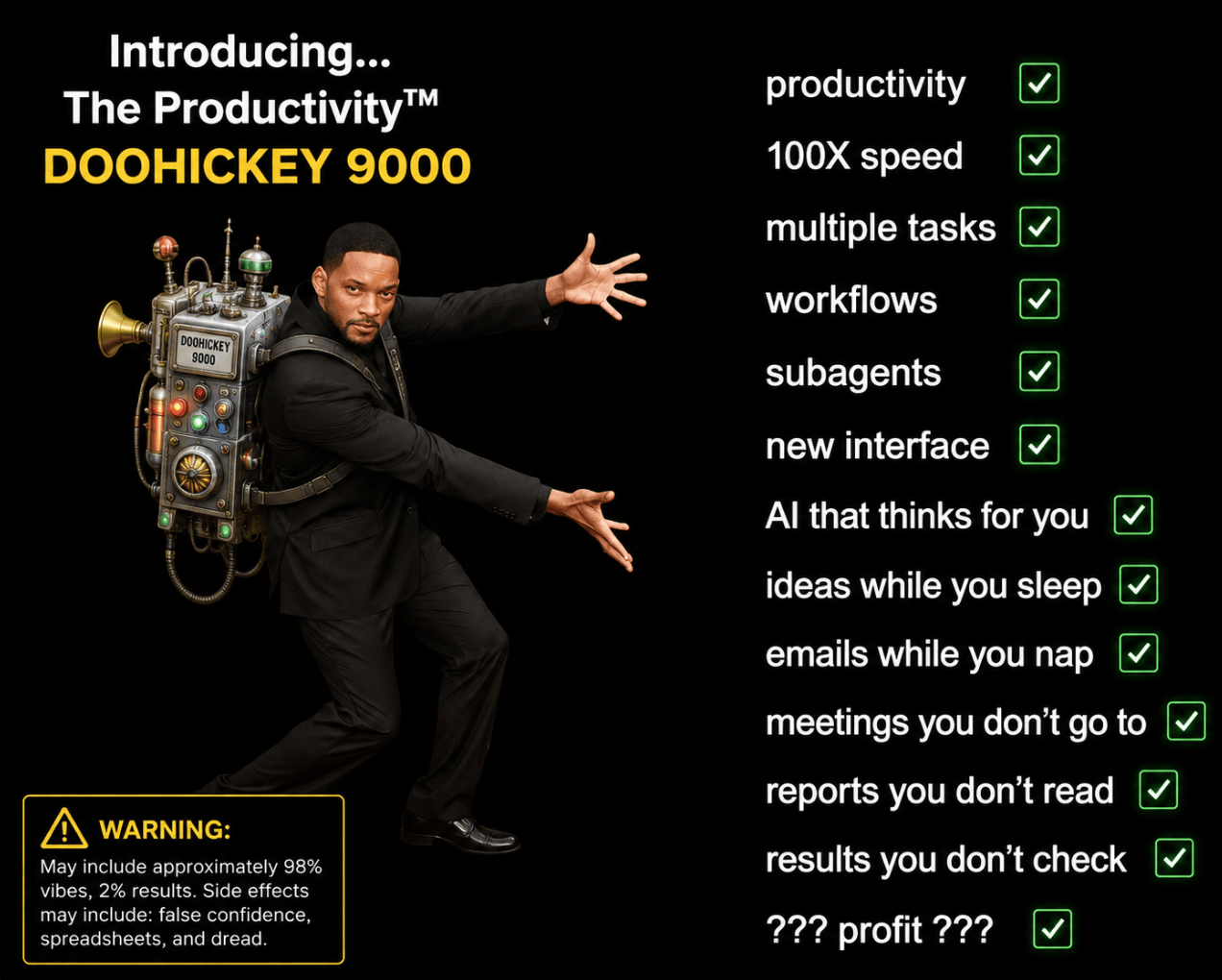
Apparently, the future of business is 1,000 agents, 20 monitors, a glowing orb, and a founder issuing commands from a hiking trail. Before anyone buys the command center, there is a simpler question worth asking: Did any of it produce useful work?
Artificial intelligence demonstrations have developed a familiar rhythm. A founder stands in front of a glowing command center, wakes up a digital assistant with a phrase that sounds borrowed from a superhero movie, and asks how the business performed overnight. The assistant responds with revenue numbers, campaign results, customer issues, product updates, and a list of recommendations—all delivered in a calm voice while animated circles pulse across several expensive monitors.
Behind the scenes, dozens of agents are supposedly working around the clock. One agent studies the market, another develops the product, several create content, another answers customers, and a few more review the work completed by the others. If the demonstration is particularly advanced, the agents also create additional agents. Productivity has increased by 100 times, the founder can now operate the company while hiking through the woods, and apparently the only remaining obstacle to unlimited growth is the number of agents currently running.
It looks impressive. It may even demonstrate some genuinely useful technology. However, the presentation usually moves quickly past the most important question:
What did the system actually produce?
Did the software work? Were the customer responses accurate? Was the generated content useful? Did the new feature solve the intended problem? How much of the output required correction? What did the system cost to operate? Did the business improve, or did it simply create an elaborate new way to watch progress indicators move across a screen?
Those questions are less exciting than announcing that 1,000 digital workers have reported for duty. They are also the questions that determine whether an agentic system has real value.
Agentic AI becomes performance theater when the appearance of autonomy, scale, and sophistication matters more than the quality, usefulness, cost, and accountability of the finished work.
Activity Is Not the Same as Progress
A business does not benefit because an agent started a task. It benefits when valuable work is completed.
That distinction sounds obvious, yet much of the current agentic AI conversation focuses on visible activity. We are shown agents creating plans, opening development threads, assigning subtasks, generating code, reviewing each other’s work, and producing status reports explaining what all the other agents are doing. The system appears extremely busy, and that busyness is presented as evidence of productivity.
The problem is that output and outcome are not the same thing.
An AI system can generate thousands of lines of code, hundreds of advertisements, dozens of reports, and enough social media posts to make the entire internet noticeably worse. Those are outputs. The business outcome might be a dependable feature customers can use, a campaign that generates qualified sales, a report leadership trusts, or a workflow that reduces the amount of time employees spend searching for information.
More output does not guarantee a better outcome. It may simply create more material for someone to inspect, correct, reject, and maintain. AI can now generate work faster than many organizations can determine whether that work should exist in the first place.
If a system produces ten times as much content and people discard 90% of it, productivity may not have increased at all. The business may have simply invented a much faster way to fill the trash can.
“A thousand agents can still misunderstand the assignment. Adding more dashboards, voices, screens, and glowing status indicators does not fix an unclear workflow. It only makes the misunderstanding look more expensive.”
Levi Beers, Co-Founder, Keystone Web Studios Tweet
“100x Productivity” Usually Avoids Defining Productivity
Claims of 10-times or 100-times productivity sound scientific because they include a number. What they often lack is a meaningful definition of productivity.
What increased by 100 times? Was it the amount of code generated, the number of tasks opened, the number of messages exchanged between agents, or the speed at which an initial draft appeared? Was the finished work reviewed, accepted, deployed, and used? Did anyone measure the complete workflow before and after the system was introduced?
Generating code quickly does not mean the software is secure, maintainable, or aligned with what the business needs. Producing 100 marketing ideas does not mean any of them are good. Automatically creating several reports does not help if leadership cannot trust the information inside them.
AI can absolutely create substantial productivity gains. I use AI every day, and Keystone Web Studios builds systems specifically to reduce repetitive work and help organizations move faster. The problem is not the idea that AI can improve productivity. The problem is declaring victory before defining the baseline, the finished outcome, or the effort required to validate what the system produced.
A serious productivity claim should account for the entire workflow. How long did the work take previously? How long does it take now? How much review remains? How many corrections are required? What new operating costs were introduced? Did the result maintain or improve the required level of quality?
Without those answers, “100x productivity” is not a measurement. It is decoration for a thumbnail.
A Thousand Agents Is Not a Business Strategy
Agent count is becoming a new kind of vanity metric. One agent sounds practical, ten agents sound advanced, and a thousand agents apparently represent the moment when every confusing AI investment finally starts producing a return.
The logic seems to be that companies have struggled to find value because they have not deployed enough autonomous workers. Fifty agents were insufficient. Two hundred agents were timid. Once every employee commands a thousand agents, everything will presumably become clear.
There is a small problem with this theory: every agent introduces another interpretation, another handoff, another model call, another operating cost, and another place where context can be lost.
Multiple agents can be useful when they perform genuinely distinct roles. A planning process may benefit from separate execution and validation steps. A document workflow may use specialized components for classification, extraction, conflict detection, and review preparation. Those responsibilities can make the system more reliable when the boundaries are clear and each component earns its place.
However, adding agents does not automatically add intelligence. Several agents can share the same flawed assumption. One agent can confidently review another agent’s incorrect work. A group of models agreeing with one another is not the same as independent experts validating a result.
Complexity should solve a problem. It should not exist because an orchestration diagram with 47 boxes looks more impressive on LinkedIn.
A business does not need the largest digital workforce it can afford. It needs the smallest dependable system capable of improving the outcome.
A Command Center Is Not a Business System
Some agentic AI interfaces look less like business software and more like movie props. There are glowing spheres, animated radar screens, voice assistants that insist on calling the user “sir,” and enough wall-mounted hardware to suggest that someone is tracking submarines rather than reviewing a marketing campaign.
The presentation creates an immediate sense of sophistication. A spoken assistant can announce that revenue increased, advertising performance changed, customers requested a feature, and a development agent has already prepared the code. The founder listens thoughtfully before ordering another group of agents into action.
It is dramatic. It may also be a slower way to read a dashboard.
Voice interfaces can be useful. They can capture ideas while someone is driving, provide a simple status update when a screen is unavailable, create reminders, or help a person interact with a system while performing another task. They become less helpful when someone must compare several projects, retain numerous details, consider tradeoffs, and make important decisions based entirely on information delivered sequentially through an earpiece.
Visual information exists for a reason. A well-designed dashboard allows people to scan, compare, revisit, and investigate. A spoken report forces the listener to remember what was said three minutes ago while the assistant continues describing project number four.
The best interface is the one that fits the decision. Voice is not automatically progress, and a pulsing blob is not automatically better than a clearly labeled table.
Good system design begins with the information a person needs, the decision that person must make, and the clearest way to support that decision. The purpose of an interface is not to make routine work feel like a scene from a science-fiction film. It is to make the work easier to understand and act upon.
Human Thought Is Not an Inefficiency to Eliminate
Some AI commentary treats every form of human involvement as a defect waiting to be automated. Writing the specification is manual. Reviewing the work is manual. Testing is manual. Discussing tradeoffs is manual. Clarifying the idea is manual. Eventually, even having the initial idea begins to look like an unreasonable burden.
Why manually think your own thoughts when an agent could generate some for you?
This view confuses participation with waste.
In real projects, requirements are rarely complete at the beginning. They develop through conversations, prototypes, disagreements, discoveries, and changes in direction. A business owner may see an early version and realize that the original idea does not solve the intended problem. An employee may identify an exception that occurs every day but never appeared in the official process. A technical constraint may reveal a simpler and more valuable approach.
Those moments are not evidence that the planning failed. They are part of the process through which a vague idea becomes a useful system.
A specification can document what everyone currently believes, but it cannot eliminate uncertainty. When an autonomous system fills that uncertainty with its own assumptions, the result may be technically coherent while being completely wrong for the organization.
The goal of agentic systems engineering is not to remove people from thinking. It is to remove avoidable effort so people can spend more time on the parts of the work that require judgment, experience, accountability, and context.
Automated Execution Can Become Automated Assumption
Agentic systems are powerful because they can continue working across several steps. They can inspect information, select tools, perform actions, evaluate results, and adjust their approach. That ability is extremely valuable when the objective and boundaries are clear.
It becomes risky when the request is vague and the system is allowed to make increasingly important decisions without visibility.
Imagine giving an agent a general product idea and asking it to create a complete specification. The agent asks several questions, interprets the responses, fills in missing details, and produces an extensive plan. Another agent begins building from that plan while additional agents test, review, and revise the output.
The process may look disciplined, but many of the most important product decisions were made through inference. The system may have chosen the user flow, data structure, permission model, interface behavior, and definition of success without any person explicitly approving those decisions.
The longer the loop runs, the more those assumptions accumulate. By the time someone reviews the finished product, the system may have built an enormous amount of work around an interpretation that was wrong from the beginning.
The AI may have followed the plan perfectly. The problem is that the same system partially invented the plan it followed.
Autonomy should therefore be proportional to clarity. The less certain the organization is about what the finished work should be, the more important human participation becomes.
Agentic Loops Are Useful When the Work Is Bounded
The answer is not to reject agentic systems. Properly designed loops can perform valuable work that would otherwise consume hours of employee time.
A strong candidate has a defined objective, dependable inputs, permitted tools, testable completion criteria, limited authority, recognizable failure conditions, and a person or team responsible for the result.
An agentic document workflow, for example, may receive client records, classify each file, extract required information, compare the findings with existing data, flag conflicts, and prepare a structured profile for employee review. The system can repeat parts of the process when validation fails, but it should not silently decide which conflicting information becomes official.
A marketing workflow might analyze customer behavior, identify people who may be interested in a relevant offer, prepare recommended messaging, and place those recommendations into a review queue. The system performs the repetitive analysis and preparation while the business retains authority over what is communicated and how customers are treated.
These systems can coordinate several tools and make limited decisions without requiring a person to approve every technical action. Their value comes from the fact that the work is understood, the boundaries are explicit, and the final result can be reviewed.
At Keystone, we use autonomy where the boundaries are clear and human judgment where the consequences are not.
Customer Communication Is More Than a Response Count
One of the most appealing agentic demonstrations involves a digital assistant announcing that it handled most customer messages automatically. The report sounds efficient: a certain number of emails arrived, the agent resolved nearly all of them, and only a few unusual cases required attention.
That statistic means very little without knowing what the customers actually experienced.
Did the system understand what each person needed? Were the responses accurate? Did the customer know AI was involved? Was there a clear way to reach a person? What happened when frustration, urgency, or context did not match the system’s expected patterns?
Customers generally do not celebrate being prevented from speaking to a human being. A fast automated answer that misunderstands the problem may reduce a response-time metric while damaging the relationship.
AI can help classify requests, retrieve account information, draft replies, and resolve carefully defined routine issues. Those capabilities should operate within clear escalation rules, quality controls, disclosure decisions, and human ownership. The business remains responsible for the experience even when an agent wrote the message.
The goal is not to maximize the percentage of customers handled without people. The goal is to solve customer problems accurately, respectfully, and efficiently.
Content Volume Can Become Industrialized Waste
AI makes it possible to generate more content than a business could ever produce manually. Some systems boast of publishing dozens of videos per day across scores of accounts while producing endless variations of advertisements, scripts, captions, and promotional assets.
The scale sounds impressive until someone looks at the content.
If the system keeps repeating the same shallow ideas, creates material that audiences ignore, or floods platforms with forgettable variations, the business has not created a sophisticated marketing engine. It has created a slop factory with a cloud bill.
Effective marketing is not measured only by how much material was published. It should be useful, distinctive, credible, and connected to a real customer need. More content can help when the additional output allows a business to test thoughtful ideas, serve different audiences, and learn from measurable results. Volume becomes harmful when it replaces the thinking required to create something worth seeing.
Automation can scale quality, but it can also scale mediocrity. The technology does not decide which one the business receives.
Human Review Is Not Babysitting
Human review is sometimes described as an unfortunate limitation that future models will eliminate. In practical systems, review serves several purposes that are not temporary.
A person may approve a consequential action, apply professional judgment, investigate an exception, verify evidence, or provide context that the system does not possess. Those responsibilities do not exist merely because AI is imperfect. They exist because the organization has decided where authority and accountability belong.
Poorly designed review can eliminate the value of automation. If an employee must repeat the entire job to determine whether the agent completed it correctly, the system has not reduced much work. It has simply transformed the employee from the person performing the task into the person auditing an opaque machine.
Good review looks different. The system identifies uncertainty, highlights conflicts, preserves links to source information, and directs the person’s attention toward the parts that require judgment. Dependable routine work moves forward efficiently, while unusual or higher-risk situations receive closer scrutiny.
The right question is not whether a human remains involved. The right question is whether that person’s involvement is purposeful.
Unattended Does Not Mean Free
Agentic AI is often discussed as though work becomes free once no person is actively typing. It does not.
An autonomous system may consume model tokens, search services, cloud infrastructure, storage, integration resources, monitoring tools, and repeated retries. Someone must maintain the workflow, investigate failures, review exceptions, and respond when an outside service changes. Security, privacy, and compliance responsibilities do not disappear because an agent is performing the task.
An agent that works all night may create valuable results. It may also spend all night generating, reviewing, and revising work that nobody needed.
The cost may be justified when the outcome matters. It should still be measured.
A responsible implementation compares the value of the approved result with the full cost of producing, verifying, operating, and maintaining it. A system is not efficient simply because the invoice arrived from a model provider instead of payroll.
Fear of Being Left Behind Is Not a Business Case
A great deal of agentic AI marketing is built around fear. Businesses are warned that competitors will soon operate continuously, replace entire departments with agents, and move at a speed no ordinary organization can match. Anyone who hesitates will supposedly be left behind by founders who run their businesses through voice commands while walking through a forest.
Urgency can be useful when a real opportunity exists. It becomes dangerous when it causes an organization to skip discovery, measurement, security, employee involvement, and basic economic evaluation.
A business should adopt an agentic system because it has identified valuable work the system can perform reliably. It should not deploy agents merely because someone online claims that every employee will soon manage a thousand of them.
Fear of being left behind is not a workflow. It is not an outcome, a technical requirement, or a return on investment.
The best protection against falling behind is not copying every dramatic demonstration. It is developing the ability to distinguish a useful capability from a fashionable performance.
Show the Finished Work
When evaluating an agentic system, businesses should look beyond the machinery. A workflow diagram and a screen full of active agents may demonstrate that the system is doing something. They do not prove that it is doing the right thing.
A meaningful demonstration should show the original objective and the finished result. It should reveal where the system struggled, what assumptions it made, and how exceptions were handled. It should account for the time employees spent reviewing and correcting the output, as well as the cost of the models, services, and retries used to produce it.
The demonstration should also make accountability clear. Who approved the result? Who could reject or stop the process? Who was responsible when the output was wrong? “The agents handled it” is not an accountability model.
Most importantly, the business should be able to explain what improved. Did employees spend less time searching, copying, or repeating work? Did customers receive better service? Did the system reduce errors, missed follow-up, or documentation gaps? Was the benefit worth the cost?
These questions are not as visually exciting as watching dozens of agents launch simultaneously. They are far more useful.
The Keystone Standard
At Keystone Web Studios, we begin with the workflow and the outcome rather than the spectacle. We study how work actually moves through an organization, including the workarounds, delays, decisions, approvals, and responsibilities that may not appear in the official process.
From there, we determine what should be handled through traditional automation, what may benefit from AI, and what should remain under direct human control. The final system may include custom software, integrations, AI-assisted interpretation, agentic execution, and human review. Those components are selected because they support the work—not because they produce the busiest-looking dashboard.
We are not interested in maximizing the number of agents, prompts, devices, or generated artifacts. We are interested in reducing total effort, producing inspectable results, and helping organizations accomplish something that matters.
Agentic AI has the potential to change how businesses operate. That potential will not be proven by louder claims, increasingly elaborate command centers, or creative new ways to avoid looking at the finished product. It will be proven by the quality of the work, the clarity of the controls, the responsibility of the implementation, and the results the organization can measure.
Before celebrating how many agents are running, show us what they finished, what it cost, who reviewed it, and whether the business is better because it exists.