Why successful AI systems begin with understanding the work, the people, and the outcome—not the technology.
Business owners are constantly hearing about what artificial intelligence can do. AI can summarize documents, draft emails, answer questions, create reports, analyze information, and complete work across multiple software systems. With so many possibilities, it is understandable that the first question often becomes, “What can we build with AI?”
That is usually the wrong place to begin. Most businesses do not need more technology simply for the sake of having it. They need fewer delays, less repetitive work, better access to information, more consistent follow-up, and clearer decisions. AI may become an important part of the solution, but the technology itself is not the result the business is trying to achieve.
Before selecting a model, purchasing another software platform, or writing a line of code, there is a more important question to answer: Which part of the business is actually worth improving? The answer is not found in a list of AI features. It is found by studying how work moves through the organization today, where that work becomes difficult, and what a better outcome would look like.
At Keystone Web Studios, we believe the most valuable AI systems begin with that understanding. We do not start by searching for somewhere to force AI into a business. We begin by finding a workflow where a better system could produce a meaningful and measurable improvement.
A Workflow Is More Than a Task
A task is one action. A workflow includes the people, information, decisions, systems, and follow-up surrounding that action. Understanding the difference is essential because many AI experiments improve a single task without improving the overall process in which that task exists.
For example, “summarize this document” is a task. The complete workflow may begin when a customer submits several files. An employee must determine what each document contains, find the relevant information, compare it with existing records, identify what is missing, enter the results into another system, ask follow-up questions, and send the completed work to someone else for review.
An AI tool may be able to summarize the document in seconds, but that does not mean the business problem has been solved. The summary still needs a purpose. Someone may need to verify it, important information may need to remain connected to the original source, and the approved result may need to update another system or create the next task.
This is where many early AI implementations fall short. An employee may save five minutes generating a summary and then spend another fifteen minutes copying, checking, correcting, and deciding what to do with it. The individual task became faster, but the workflow remained fragmented.
A useful system must understand the complete path from the original request to the final outcome. That complete path, rather than the isolated task, is where the real opportunity is usually found.
“The biggest mistake a business can make is starting with the question, ‘What can AI do for us?’ The better question is, ‘Where are our people losing time, context, or momentum—and what kind of system would actually help them?’ Once we understand the work, the right technology becomes much easier to see.”
Levi Beers, Co-Founder, Keystone Web Studios Tweet
Look for Friction, Not Just Repetition
Repetitive work is often a good place to begin, but repetition alone does not justify building an AI system. Some repeated work can be eliminated with a better form, a clearer procedure, or a simple connection between two existing applications. Other problems are caused by unclear responsibilities, unnecessary approvals, or outdated policies rather than a lack of technology.
The goal should not be to use the most advanced tool available. The goal should be to create the simplest reliable system that improves the result. Sometimes that system will include AI. In other cases, ordinary automation or a straightforward process change may be the better answer.
Strong AI opportunities tend to share several characteristics. The work happens frequently enough that small improvements accumulate over time. Employees repeatedly gather information from documents, emails, spreadsheets, or different software platforms. The process follows recognizable patterns, but it also requires some understanding of language, context, or incomplete information.
There may also be an important human decision at the center of the process, surrounded by hours of preparation. In those situations, AI does not need to replace the decision-maker to be useful. Its best role may be to organize information, identify inconsistencies, and prepare the material a person needs to make a faster and better-informed decision.
Consider an employee who reviews a large packet of records before completing an intake. The professional judgment may take only a few minutes. Most of the burden comes from finding the relevant details, comparing conflicting information, identifying gaps, and organizing everything into a usable form. The judgment should remain with the employee, but much of the preparation surrounding that judgment may be an excellent candidate for an AI-supported workflow.
Start With the Outcome
One of the easiest ways for an AI initiative to lose direction is to define the project simply as “implementing AI.” That describes a technology choice, not a business outcome. A useful project should begin with something more specific, such as reducing processing time, improving response consistency, finding information faster, decreasing missed follow-up, or reducing repeated data entry.
The desired outcome determines what should be measured and creates a boundary around the project. Without that boundary, an AI initiative can continue expanding without becoming more useful. Features are added because they are technically interesting rather than because they improve the business.
A clear outcome leads to better questions. What is happening now? How long does the process take? Where do errors occur? Who is responsible for the final result? What would need to change for the project to be considered successful? Those questions matter more than which AI model will eventually be used.
The technology may change during development or as better options become available. The underlying business problem should remain the anchor. If the team cannot clearly explain what outcome it is trying to improve, it is too early to decide what should be built.
Study How the Work Really Happens
Written procedures are useful, but they rarely describe the entire reality of a workflow. A process document may say that an employee reviews a submission, enters the information, and sends it for approval. The actual process may involve opening several browser tabs, searching through an email thread, downloading an attachment, checking a spreadsheet maintained by one person, messaging a supervisor for clarification, and leaving a reminder to return to the task later.
That hidden work is where many of the best opportunities are found. It is also why workflow discovery cannot be limited to a conversation with leadership. Managers understand what the process is intended to accomplish, while employees understand what it actually takes to complete it. Both perspectives are necessary.
When Keystone studies a workflow, we want to understand what starts the process, what information is required, where that information comes from, and who participates. We also look at where the work waits, where information is copied or re-entered, what happens when something is missing, who reviews the result, and what action should follow.
We are especially interested in workarounds. A spreadsheet created outside the primary software, a personal checklist, or a recurring message sent to a coworker may reveal that the current system does not fully support the job. These workarounds should not automatically be treated as mistakes. They often represent employees solving problems that the official process failed to address.
The purpose of discovery is not to criticize how people work. It is to understand why they work that way, what the existing tools are failing to provide, and where a better system could remove unnecessary effort.
Decide What AI Should—and Should Not—Do
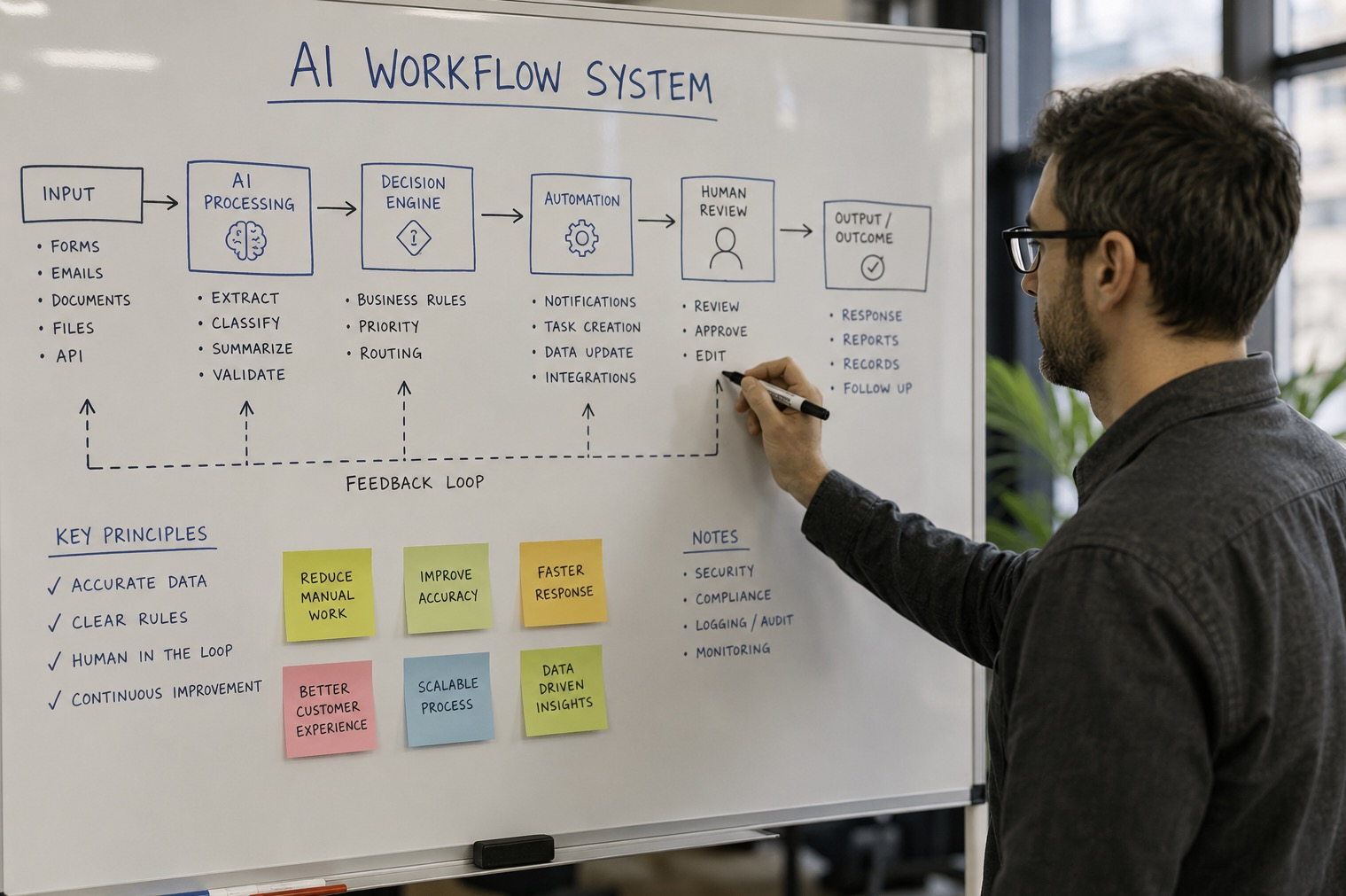
Once the workflow is understood, AI can be assigned a specific role. It may extract information from documents, organize incoming requests, summarize a history, draft a response, recommend a next action, identify a possible conflict, or monitor whether follow-up occurred. Each responsibility has a different level of risk and requires a different level of human oversight.
There is a meaningful difference between a system that drafts a customer email and one that sends the email automatically. There is also a difference between identifying a possible documentation problem and changing the official record. A system that recommends a next step is not the same as a system that makes the final decision.
That is why human review should not be treated as a disclaimer added at the end of an AI project. It must be designed into the workflow from the beginning. Employees need to know what the system produced, what information it used, where uncertainty remains, and who is responsible for reviewing or approving the result.
A well-designed system should also make correction possible. People need a clear way to change inaccurate information, reject a poor recommendation, or provide additional context. The system should record what was approved and what happened afterward so that important decisions do not disappear inside an invisible process.
Human control does not make an AI system less advanced. In many business settings, it is what makes the system trustworthy, accountable, and usable.
Know When AI Is Not the Answer
Not every workflow requires artificial intelligence. When a process follows fixed and predictable rules, traditional automation may be more dependable and less expensive. A completed contact form can create a task, send a confirmation, assign an owner, and place the request into a pipeline without using AI at all.
AI becomes more useful when the work involves language, documents, variation, context, or information that does not arrive in a perfectly structured format. An agentic system may be appropriate when several steps must be coordinated across tools, such as receiving a request, gathering relevant records, preparing a recommendation, routing the work for approval, and recording the approved outcome.
Even then, the best solution may combine several technologies. A practical business system may contain ordinary software rules, database queries, integrations, AI-assisted interpretation, and human review. The customer does not benefit from labeling every component as AI-powered. The customer benefits when the entire system works reliably.
Sometimes the correct recommendation is to improve the process before building anything. If no one agrees on how the workflow should operate, automation may only make the disagreement harder to see. If the source information is unreliable, AI will not make it reliable. If employees cannot determine whether an output is correct, the organization may not be ready to depend on it.
One of the most important responsibilities in AI systems engineering is knowing when not to build. A trustworthy technology partner should be willing to recommend a simpler or less expensive solution when it better fits the problem.
Choose a Focused First Project
The best first AI project is usually not the company’s largest or most ambitious process. It is a focused workflow with a clear beginning, a clear outcome, and a person responsible for the result. The organization should have access to the information required to perform the work, and employees should be able to review what the system produces.
A strong pilot might involve reviewing incoming documents, preparing information for employee approval, categorizing and routing requests, drafting follow-up communication, identifying incomplete records, or producing a recurring internal report. These workflows are limited enough to study carefully but valuable enough to demonstrate whether the approach works.
The pilot should test more than whether the technology functions. It should show whether employees understand what the system is doing, whether corrections are easy, whether the review process saves time, and whether the output helps someone complete meaningful work.
A technically successful pilot can still fail operationally. Software may perform exactly as designed while employees avoid using it because the design does not reflect their real responsibilities. That is why the people who perform the work must be involved before, during, and after the pilot.
Consider a Document-Heavy Intake Process
Imagine an organization that receives multiple documents for every new client. An employee opens each file, locates important information, copies details into another system, identifies missing answers, compares inconsistent records, and prepares the intake for review.
It would be easy to describe the proposed solution as “using AI to read documents,” but that description misses most of the value. A better workflow could receive the uploaded files, identify the type of each document, extract relevant information, and keep every proposed fact connected to its original source.
The system could flag missing or conflicting details instead of silently selecting an answer. An employee could review the information, make corrections, and approve the final record. After approval, the system could prepare follow-up questions, update the next step in the process, and preserve a clear history of what occurred.
The value is not simply that a machine read a PDF. The value is that the organization moved from a collection of disconnected files to an approved, evidence-supported record that someone can use. That is the difference between adding an AI feature and improving an entire workflow.
The Right Workflow Is Found Before It Is Built
A successful AI system begins long before development. It begins by listening to the people who perform the work and understanding the outcome the business needs to improve. It also requires examining the information involved, the decisions being made, and the places where human responsibility must remain.
This discovery work is not a delay before the real project begins. It is the foundation of the project. Without it, even technically impressive software can solve the wrong problem or create additional work for the people expected to use it.
At Keystone Web Studios, we combine operational discovery with technical systems design. We study how work moves through an organization before recommending what should be automated, what should be AI-assisted, and what should remain under direct human control.
That process may lead to traditional automation, an internal tool, a document-processing system, an agentic workflow, or a combination of several approaches. We are not committed to forcing every business problem into the same product. We are committed to finding the system the business actually needs.
Before building AI, first find the workflow where a better system would make a measurable difference. Then build around the work, the people, and the outcome—not around the technology.