Artificial intelligence demonstrations are easy to make impressive. A system summarizes a long document in seconds, prepares a professional response, identifies patterns across hundreds of records, or completes a sequence of tasks that previously required several people and multiple software applications.
During a demonstration, everything appears to work. The input is clean, the desired result is clear, and the system responds exactly as expected. Leadership sees an opportunity to save time, reduce costs, or improve service. The pilot is approved, development begins, and everyone expects the technology to produce the same results inside the business.
Then the real work arrives.
Documents are incomplete. Employees perform the same process differently. The information the system needs is spread across email, spreadsheets, shared drives, and software that does not communicate with anything else. No one is certain who should review the AI’s output, and the people expected to use the system were not involved in designing it.
The technology may still be functioning exactly as intended. The pilot can nevertheless fail.
This is one of the most important lessons in practical AI implementation: a technically successful system is not automatically a successful business system. The difference is determined by how well the technology fits the workflow, the people, the responsibilities, and the outcome the organization is trying to improve.
A Demonstration Is Not a Workflow
A demonstration proves that a technology can perform a task under a controlled set of conditions. A working business system must perform that task as part of a larger process involving real people, imperfect information, changing priorities, and consequences.
For example, an AI system may demonstrate that it can review a document and identify important information. That capability may be accurate and valuable, but it does not answer several operational questions. Where will the document come from? How will the system know what type of document it received? What happens when pages are missing or the information conflicts with another record? Who determines whether the extracted information is correct? Where does the approved result go, and what should happen next?
The demonstration usually focuses on the moment when the AI produces an answer. The workflow includes everything that happens before and after that moment.
This difference is why many pilots seem successful in a meeting but become difficult once employees begin using them. The technology completed its assigned task, but the surrounding process was never fully designed. Employees are left to create their own review steps, move information between systems, resolve errors, and determine who is responsible for the final outcome.
A business does not adopt an AI response. It adopts a new way of working. If that new way of working is unclear, the pilot will struggle regardless of how impressive the underlying technology may be.
“A pilot is not successful because the AI produced the right answer in a demonstration. It is successful when the system fits the real workflow, employees understand their role, and the business is measurably better because it exists. Technology can work perfectly and still solve the wrong problem.”
Levi Beers, Co-Founder, Keystone Web Studios Tweet
The Pilot Solved the Wrong Problem
Some AI pilots fail because the team begins with a capability rather than a business problem. Someone discovers that AI can summarize calls, generate sales emails, classify requests, or search internal documents. The organization then looks for somewhere to use that capability.
This approach can produce an interesting experiment, but it often creates a weak business case. The organization may successfully automate an activity that was not causing meaningful difficulty in the first place.
An employee who spends ten minutes each week preparing a report may appreciate having it generated automatically. However, that improvement may not justify the time, cost, risk, and ongoing maintenance required to build a custom system. Meanwhile, another workflow may consume several hours each day because employees repeatedly search for information, re-enter data, wait for approvals, and correct avoidable mistakes.
The more valuable opportunity is not always the most obvious AI use case. It is the workflow where improvement would have a measurable effect on time, revenue, quality, service, or employee workload.
A strong pilot begins with an outcome such as reducing intake processing time, improving the consistency of follow-up, identifying missing documentation earlier, or helping employees find critical information faster. The AI capability is then selected because it supports that outcome.
When the technology is chosen first, the team is often forced to defend the project by pointing to what the system can do. When the workflow and outcome are chosen first, the team can evaluate whether the system actually made the business better.
The Real Workflow Was Never Studied
Organizations usually have an official description of how work is completed. The official process may be written in a policy, training document, checklist, or software manual. That information is valuable, but it rarely captures the entire workflow.
The real process may depend on an employee who knows where to find an old spreadsheet, a manager who answers recurring questions through text messages, or a personal checklist someone created because the primary software does not provide the information in a useful format. Employees may complete extra steps that leadership does not know about because those steps are necessary to produce an acceptable result.
When an AI system is designed around the official process alone, those hidden requirements are missed. The system may function correctly according to the documentation while failing to support the way the job is actually performed.
This can create a frustrating result for employees. Instead of reducing work, the pilot becomes another tool they must manage. They may have to enter information twice, correct outputs without understanding why they were wrong, or continue using their existing workaround because the new system does not handle an important exception.
Workflow discovery must include the people who perform the work. They understand where the process slows down, which information is difficult to find, what happens when something goes wrong, and which decisions require judgment that cannot be reduced to a simple rule.
Their participation should not begin after the system has already been designed. By then, the most important assumptions may already be built into the pilot.
Employees Do Not Trust What They Cannot Understand
Trust is sometimes treated as a training problem. If employees hesitate to use an AI system, leadership may assume that they need a better explanation of the technology or more encouragement to adopt it.
In some cases, the employees’ hesitation is reasonable.
They may not know where the AI obtained its information, whether the result has been verified, or who will be held responsible if the output is wrong. They may have seen the system produce a confident answer that was incomplete or misleading. They may also understand risks in the workflow that were not considered during development.
A trustworthy system should make its role clear. Employees should know what the AI has done, what information it used, what remains uncertain, and what they are expected to review. When possible, important outputs should remain connected to their source material so that users can verify the result without repeating the entire process manually.
The system should also provide a clear way to correct mistakes. If an employee identifies inaccurate information, that correction should be easy to make and meaningful to the workflow. A system that repeatedly creates the same error while requiring manual cleanup will quickly lose support.
Trust does not come from telling employees that AI is powerful. It comes from designing a system that is understandable, reviewable, and accountable.
No One Owns the Outcome
A pilot may involve technology, operations, leadership, and outside vendors, but still have no clear owner.
The development team may be responsible for making the software function. An operations manager may be responsible for the existing workflow. Employees may be responsible for reviewing the output. Leadership may be responsible for deciding whether the pilot continues. When those responsibilities are not clearly defined, important decisions fall between roles.
Someone must own the business outcome, not merely the technology.
That owner should understand why the pilot exists, what result it is expected to improve, who will use it, and how success will be measured. The owner should also have enough authority to resolve workflow questions and make decisions when the pilot exposes problems in the existing process.
Ownership is especially important when the AI produces recommendations, drafts, or proposed changes. The organization must determine who reviews the output, who approves the final action, and who is accountable for the result.
Without clear ownership, employees may assume someone else has verified the information. Managers may believe the development team is monitoring operational performance. The development team may believe the client is reviewing every result. The technology continues operating, but no one is responsible for determining whether it is helping.
Human Review Was Added Too Late
Many pilots describe themselves as “human in the loop,” but the review process is often treated as a final safety step rather than part of the system’s design.
A developer may build the AI workflow first and then add a screen where an employee can approve or reject the result. Technically, a person is involved. Operationally, the review may be impractical.
If the employee has to reopen every source document, compare every field, and reconstruct the AI’s reasoning, the review process may take as long as completing the original work. The system has not removed the burden; it has merely changed its form.
Effective human review should be designed around the decision the employee needs to make. The system should present the relevant information clearly, identify uncertainty, highlight conflicts, and preserve evidence where verification matters. The reviewer should be able to understand what requires attention instead of treating every output as equally suspicious.
The organization must also decide what level of autonomy is appropriate. An AI system may be allowed to organize information automatically while requiring approval before changing an official record. It may draft a customer response but not send it. It may identify a possible risk but leave the final determination to a qualified employee.
These boundaries should be established before development. Adding human review after the system is built can create an awkward approval layer rather than a dependable workflow.
The Pilot Created More Work Than It Removed
AI pilots are often evaluated by the speed of the automated task rather than the total amount of work created by the system.
A tool may generate a report in thirty seconds, but employees may spend fifteen minutes correcting the format, verifying the numbers, and transferring the result into another application. A chatbot may respond to customer questions instantly, but staff members may spend more time monitoring conversations and repairing inappropriate responses than they previously spent answering the questions directly.
The correct comparison is not between the AI’s speed and the employee’s speed at one isolated task. The comparison must include the entire workflow.
This includes preparation, review, correction, communication, system maintenance, exception handling, and follow-up. It also includes the mental burden placed on employees who must constantly decide whether the output can be trusted.
A successful system should reduce the total effort required to produce a dependable result. It should not simply move work from one part of the organization to another.
This is why measuring the current process before launching a pilot is so important. Without a baseline, the organization may know that the AI is producing outputs but have no reliable way to determine whether the workflow improved.
Success Was Never Defined
A pilot can continue for months while different people hold different ideas about what success means.
Leadership may expect cost savings. Employees may expect the system to reduce administrative work. The development team may consider the pilot successful because the software is functioning correctly. A department manager may be waiting for better reporting or faster turnaround times.
All of these outcomes may be reasonable, but they are not interchangeable.
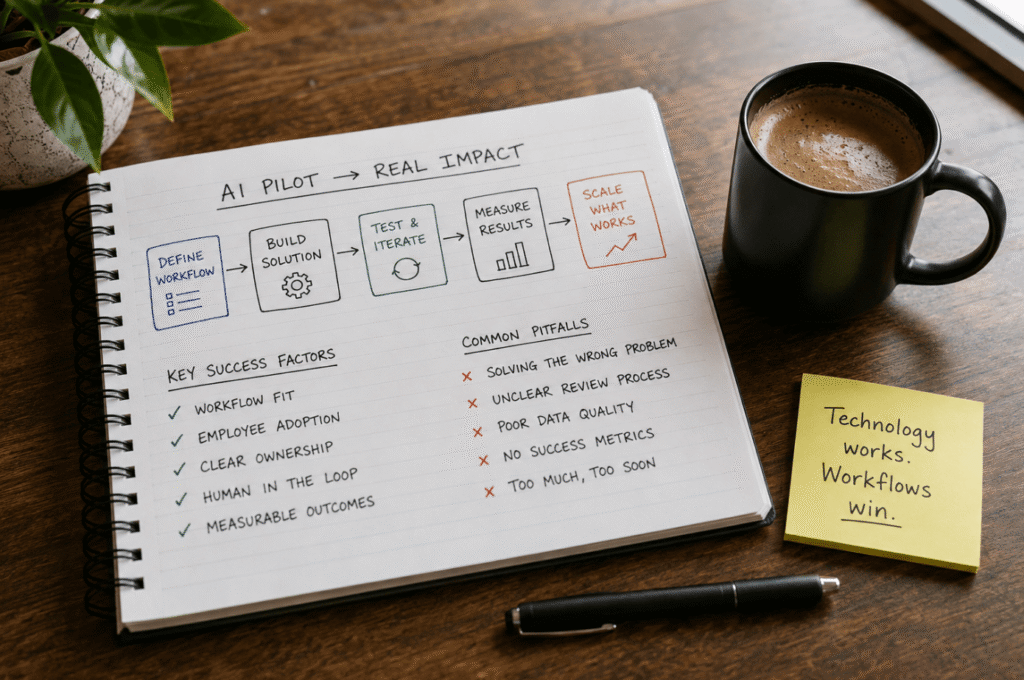
A pilot should begin with a small number of specific measurements connected to the business problem. These may include processing time, number of corrections, percentage of completed follow-ups, employee adoption, response time, documentation gaps, customer satisfaction, or revenue associated with the workflow.
Not every benefit can be reduced to a single number. Employee confidence, clarity of responsibility, and access to better information may also matter. However, the organization still needs an agreed-upon method for evaluating whether the pilot should be improved, expanded, redesigned, or stopped.
A pilot without defined success criteria can easily become permanent because no one is prepared to declare that it failed. It can also be abandoned prematurely because the organization never identified the value it was supposed to create.
The Pilot Was Too Large
AI creates pressure to think broadly. Once an organization sees that a system can read documents, communicate with customers, interact with software, and recommend actions, it becomes tempting to combine all of those capabilities into the first project.
The result is often a pilot that attempts to transform an entire department before the organization has tested one dependable workflow.
Large pilots contain too many unknowns. If performance is poor, it becomes difficult to determine whether the problem comes from the AI, the data, the integrations, the user interface, the approval process, or the workflow itself. Employees are asked to change too much at once, and the project becomes expensive before its value has been demonstrated.
A better pilot has a defined beginning and end. It serves real users, works with real information, and produces an outcome that matters. The scope should be large enough to test the complete workflow but small enough that the organization can understand what happened.
The purpose of a pilot is not to build a smaller version of the final system. It is to learn whether the proposed approach works inside the actual business.
A Successful Pilot Changes the Work
Consider an organization that receives documents from new clients. Employees review the files, locate relevant information, identify missing details, enter data into another system, and prepare the record for approval.
An AI demonstration may show that a model can extract information from one of those documents. A successful pilot must go further.
The system must receive the files in a dependable way, identify what each document contains, extract the relevant information, preserve the connection to the source, and flag missing or conflicting details. An employee must be able to review the proposed information without repeating the entire intake process. Once approved, the result should move into the correct system and trigger the appropriate next step.
The value does not come from proving that AI can read a document. The value comes from improving the path between receiving the documents and creating an approved, usable record.
That difference is central to how Keystone Web Studios approaches agentic systems engineering. We are not only interested in whether a model can perform a task. We study how that task fits into the people, systems, decisions, and responsibilities surrounding it.
Technology Is Only One Part of the System
A successful AI pilot requires dependable technology, but technology alone is not enough. The system must reflect how the business actually operates, give employees a clear role, preserve appropriate human control, and improve an outcome the organization can recognize.
This is why discovery, workflow design, and implementation planning are not optional steps before development. They are part of the engineering.
At Keystone Web Studios, we begin by understanding the work. We identify where information comes from, how decisions are made, where delays occur, and what employees need in order to trust and use the result. We then determine what should be handled by traditional software, what may benefit from AI, and where human judgment must remain.
The final solution may include AI models, ordinary automation, custom software, system integrations, and employee review. The individual components matter, but the business experiences them as one system.
An AI pilot should not be judged only by whether the technology worked. It should be judged by whether the organization works better because the technology is there.
Related Keystone resources: Sustainable pilots require ongoing support and improvement, governed custom AI agents, and a clear proof and credibility standard.